
Amit Kapur, Founder, Chairman & Managing Director, NICO Nanobubble India Co.
Semiconductor Industry: Water Quality Imperatives and Strategic Challenges
Semiconductor and advanced electronics manufacturing is fundamentally dependent on ultrapure water (UPW). UPW is used across critical steps such as wafer cleaning and rinsing, photolithography support operations, etching, plating/anodic processes in adjacent electronics lines, Chemical Mechanical Planarization (CMP) support rinses, and chemical dilution where applicable. As device geometries continue to shrink and defect tolerance narrows, the water specification envelope becomes increasingly stringent not only for ionic purity and Total Organic Carbon (TOC), but also for microbiological stability, particulate control, and chemical consistency across distribution.
In modern fabs, the primary UPW generation system (pre-treatment → Reverse Osmosis (RO) → Electrodeionization (EDI)/mixed bed → UV/degassing → final polishing filtration) is typically robust. However, challenges intensify downstream and in reuse contexts particularly in cascade rinse loops, drag-out recovery tanks, intermediate storage, and recirculating rinse baths. These loops are vulnerable to conductivity drift caused by process drag-out, episodic organic loading, microbial regrowth in low-nutrient conditions, and biofilm formation in low-flow or stagnant sections. Even when bulk water meets UPW specifications at the point of production, downstream instability can impose operational penalties: more frequent tank dump-and-refill cycles, higher downtime for cleaning, higher filter replacement frequency, reduced reuse fraction, and increased risk of yield impacting contamination events.
Sustainability targets and water neutrality commitments are further compressing the solution space. The industry increasingly needs “add-on” technologies that stabilize water quality in real time, reduce reliance on chemicals, and enable higher reuse without compromising production reliability.
Current Technology Approaches and Where Gaps Persist
Semiconductor UPW management and reclaim typically relies on combinations of membrane separation, ion removal, oxidation, and disinfection. In practice, RO and EDI effectively control dissolved solids and ionic load, UV oxidation can reduce organics, and final filtration removes residual particulates. Yet, the recurring issue in rinse and reuse loops is not the absence of treatment tools, but the persistence of dynamic contamination mechanisms. Small but continuous ionic ingress via drag-out, biofilm establishment driven by trace organics and micro-niches, and microbial instability that periodically accelerates TOC and conductivity rebound.
Chemical dosing is often used as a compensatory measure in auxiliary loops, but it introduces its own risks in sensitive environments such as secondary residues, compatibility constraints, added monitoring requirements, and sustainability burdens. The result is a structural need for a non-chemical conditioning method that can operate continuously, integrate easily, and reduce the volatility of water quality in reuse systems.
Why Nanobubbles Matter in UPW-Adjacent and Reuse Loops
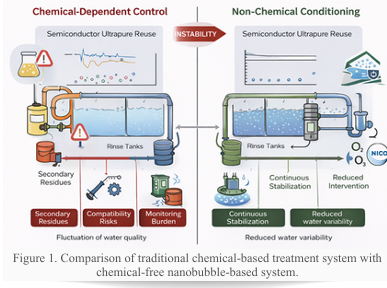
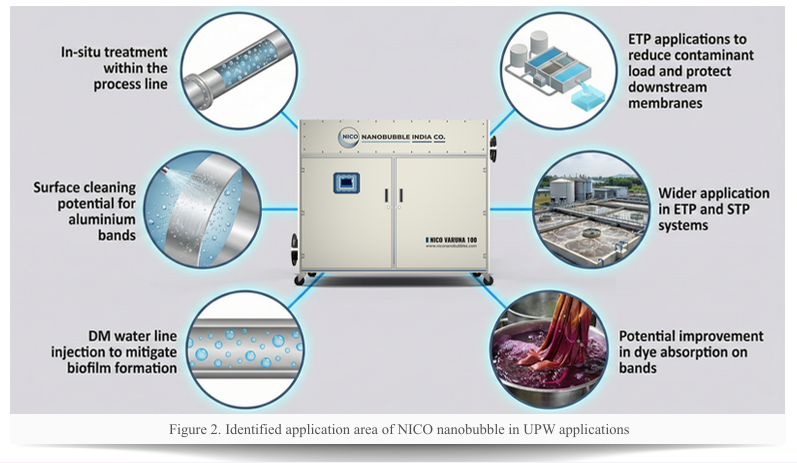
NICO Nanobubbles are generated using gases (oxygen/air/ozone), they increase oxygen availability uniformly and can reduce anaerobic microzones that promote nuisance growth and biofilm persistence (Figure 1). Ozonated nanobubbles (in controlled configurations) support localized oxidation pathways and improved contact efficiency, enabling rapid suppression of microbial activity and oxidation of trace organics that contribute to regrowth and fouling. In practical terms, this translates to improved stability of rinse loop water quality, reduced biofilm attachment, and lower frequency of manual cleaning and tank replacement.
Importantly, nanobubble systems can be positioned as a complementary module rather than a replacement for RO/EDI. In most semiconductor water architectures, nanobubbles are most impactful in “between-unit” and “downstream” zones such as rinse recovery tanks, cascade rinse loops, intermediate storage, and distribution segments where residence times and micro-environments are favourable for instability.
Generalized Outcomes from Recent Semiconductor Collaboration
In a recent collaboration with a leading semiconductor-related manufacturing facility (project details are generalized due to confidentiality requirements), NICO’s nanobubble technology was integrated into select rinse/reuse loop segments as a conditioning & stabilization layer. The system was configured to operate continuously under defined control logic, with performance tracked through operational water quality indicators and system stability metrics.
Across the trial window, the deployment demonstrated strong improvement in rinse loop stability, including a significant reduction in conductivity excursions, rapid reduction of organic load indicators (>90% TOC reduction) in the treated loop & robust microbial suppression relative to baseline operation (>95% algal contamination reduction). The site also observed improvements in operational continuity, reflected in reduced need for cleaning interventions & improved stability of water quality across operating hours (2x enhancement in reuse cycle). These outcomes support the role of nanobubbles as a practical, high-leverage tool for improving reuse confidence & reducing the operational friction typically associated with rinse water conservation strategies.
All reported outcomes should be interpreted as system-dependent & contingent on loop configuration, residence time, load characteristics & control philosophy. However, the demonstrated trend is consistent, NICO’s nanobubbles function as an effective stabilization mechanism in UPW adjacent loops where conventional treatment alone may not prevent biological and fouling-driven variability.
Conclusion: Nanobubbles as a Strategic Enabler for UPW Reliability and Conservation
Semiconductor water systems are entering a new phase where technical performance must be delivered simultaneously with conservation & sustainability targets. While RO/EDI/UV remain foundational, the decisive operational challenges increasingly occur in reuse loops & distribution segments where microbial volatility, biofilm, and conductivity drift impose downtime and restrict reuse scaling.
Nanobubble technology implemented with oxygen & ozone under appropriate safeguards & control provides an additional, non-chemical layer of water conditioning that directly addresses these downstream instability mechanisms. By improving biological control, reducing fouling propensity, & stabilizing key operational indicators, nanobubbles can enable higher reuse fractions, longer bath/loop stability, reduced intervention frequency & stronger alignment with water conservation objectives.